
AES-CBC — Padding Oracle Attack
A padding oracle attack is a cryptographic attack that exploits the padding mechanism in some encryption schemes, such as CBC (Cipher Block Chaining) with symmetric encryption like AES. It allows an attacker to decrypt or modify data without knowing the encryption key.
With this attack you can:
- Decrypt an encrypted message
- Encrypt an arbitrary message
What do you need to use a Padding Oracle Attack?
- The attacker must be able to:
- Modify the ciphertext.
- Send the modified ciphertext to the server.
- Receive responses to requests repeatedly.
- The vulnerable system must:
- Use a block cipher in AES-CBC (Cipher Block Chaining) mode or a similar mode that requires data padding.
- Pad data with PKCS#7.
- Indicate, explicitly or implicitly, whether the padding is correct (this can be determined from an explicit error message, different error codes, different request execution times, a service failure, or other behavior)
How padding works and why it is needed
AES is a block cipher, so to apply AES encryption/decryption a message must be split into blocks of a certain size. In other words, the message size must be a multiple of the block size. In general, we want to encrypt and decrypt messages of arbitrary size.
Therefore we need to be able to add and remove padding at the end of the message so that its size becomes a multiple of the block size.
The general scheme of applying padding during encryption:
plaintext = get_plaintext()     // Got a message of a certain size
                                // that we want to encrypt.
plaintext = pad(plaintext)      // Added padding to the end of the message
                                // so that its size is a multiple of the block size.
ciphertext = encrypt(plaintext) // After encryption we got a ciphertext
                                // whose size is a multiple of the block size.
The general scheme of applying padding during decryption:
ciphertext = get_ciphertext()   // Got the message that we want to decrypt.
                                // The size of ciphertext is a multiple of the block size.
plaintext = encrypt(ciphertext) // After decryption we got text
                                // whose size is a multiple of the block size
                                // (and matches the size of ciphertext)
plaintext = unpad(plaintext)    // Removed the padding from the end of the message
                                // so that its size matches the original size
                                // (before encryption was applied)
How PKCS#7 works
The required number of bytes is appended to the end of the message so that its size becomes a multiple of the block size. If the message size is already a multiple of the block size, a whole block is added. The value of the added bytes equals the number of added bytes.
Examples
"Hello World!1" -> "Hello World!12\x03\x03\x03"
"Hello World!12" -> "Hello World!123\x02\x02"
"Hello World!123" -> "Hello World!123\x01"
"Hello World!1234" -> "Hello World!1234\x10\x10\x10\x10\x10\x10\x10\x10\x10\x10\x10\x10\x10\x10\x10\x10"
"Hello World!12345" -> "Hello World!12345\x0f\x0f\x0f\x0f\x0f\x0f\x0f\x0f\x0f\x0f\x0f\x0f\x0f\x0f\x0f"
A possible implementation in Python:
def pkcs7_pad(data: bytes, block_size: int) -> bytes:
    if block_size <= 0 or block_size > 255:
        raise ValueError("The block size must be in the range of 1 to 255")

    pad_len = block_size - (len(data) % block_size)
    padding = bytes([pad_len] * pad_len)
    return data + padding

def pkcs7_unpad(data: bytes, block_size: int) -> bytes:
    if not data or len(data) % block_size != 0:
        raise ValueError("The data has an incorrect length")

    pad_len = data[-1]
    if pad_len <= 0 or pad_len > block_size:
        raise ValueError("Incorrect padding value")

    if data[-pad_len:] != bytes([pad_len] * pad_len):
        raise ValueError("Incorrect PKCS#7 padding")

    return data[:-pad_len]
Padding Oracle Attack - Decrypt
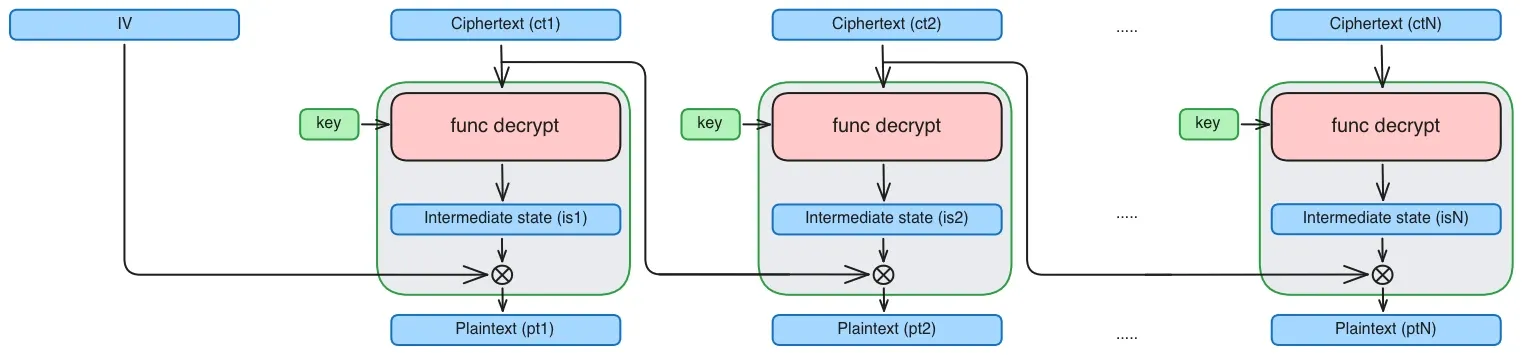
The attacker knows all the values of the Ciphertext blocks (IV, ct1, ct2, …, ctN). The attacker wants to recover all the values of the Plaintext blocks (pt1, pt2, …, ptN).
Let’s consider the decryption algorithm using the last two blocks ct1, ct2 as an example.
is2 = decrypt(key, ct2) // Compute the internal state is2
pt2 = is2 xor ct1       // Compute pt2
pt2 = unpad(pt2)        // Remove the padding
Since the padding size does not exceed the block size, unpad affects only the last block.
In which cases can the server report incorrect padding?
Correct block formats
 _  _  _  _  _  _  _  _  _  _  _  _  _  _  _  1
 _  _  _  _  _  _  _  _  _  _  _  _  _  _  2  2
 _  _  _  _  _  _  _  _  _  _  _  _  _  3  3  3
 _  _  _  _  _  _  _  _  _  _  _  _  4  4  4  4
 _  _  _  _  _  _  _  _  _  _  _  5  5  5  5  5
.....
 _  _ 14 14 14 14 14 14 14 14 14 14 14 14 14 14
 _ 15 15 15 15 15 15 15 15 15 15 15 15 15 15 15
16 16 16 16 16 16 16 16 16 16 16 16 16 16 16 16
where
_- any byte value.- a digit - the byte value in decimal.
All other formats lead to incorrect padding.
Algorithm
Notation: ct2 is the last block, ct1 is the penultimate block.
Algorithm for finding the Intermediate state of the last block:
- Check that the padding matches the format
_ _ _ _ _ _ _ _ _ _ _ _ _ _ _ 1:- Try all values of
ct1[15] - If the server replies that the padding is correct, then
is2[15] = ct1[15] xor 1- Move on to the next step
- Try all values of
- Check that the padding matches the format
_ _ _ _ _ _ _ _ _ _ _ _ _ _ 2 2:- Set
ct1[15]to2 - Try all values of
ct1[14] - If the server replies that the padding is correct, then
is2[14] = ct1[14] xor 2- Move on to the next step
- Set
- Check that the padding matches the format
_ _ _ _ _ _ _ _ _ _ _ _ _ 3 3 3:- Set
ct1[14],ct[15]to3 - Try all values of
ct1[13] - If the server replies that the padding is correct, then
is2[13] = ct1[13] xor 3- Move on to the next step
- Set
- Check that the padding matches the format
_ _ _ _ _ _ _ _ _ _ _ _ 4 4 4 4:- Set
ct1[13], ct1[14], ct[15]to4 - Try all values of
ct1[12] - If the server replies that the padding is correct, then
is2[12] = ct1[12] xor 4- Move on to the next step
- Set
- Using the same actions, find all values
is2[0], is2[1], ..., is2[16]
Algorithm for decrypting all blocks:
- While
ciphertextis not empty- Find
is2of the last block - Compute
pt2 = ct1 xor is2 - Save the result
plaintext = pt2 + plaintext - Discard the last block
- Find
- Apply
unpadtoplaintextto remove the padding plaintextwill contain the decrypted message
Example
Let’s implement the algorithm and check that it works by solving the AES-CBC-POA task. https://pwn.college/intro-to-cybersecurity/cryptography/
There is a dispatcher that encrypts a message:
#!/run/workspace/bin/python3

from base64 import b64encode
from Crypto.Cipher import AES
from Crypto.Util.Padding import pad

import sys

key = open("/home/hacker/challenge/.key", "rb").read()
cipher = AES.new(key=key, mode=AES.MODE_CBC)

if len(sys.argv) > 1 and sys.argv[1] == "flag":
    plaintext = open("/home/hacker/challenge/flag", "rb").read().strip()
else:
    plaintext = b"sleep"

ciphertext = cipher.iv + cipher.encrypt(pad(plaintext, cipher.block_size))
print(f"TASK: {b64encode(ciphertext).decode()}")task1-dispatcher.py
There is a worker that decrypts a message:
#!/run/workspace/bin/python3

from base64 import b64decode
from Crypto.Cipher import AES
from Crypto.Util.Padding import unpad
from Crypto.Random import get_random_bytes

import time
import sys

key = open("/home/hacker/challenge/.key", "rb").read()

while line := sys.stdin.readline():
    if not line.startswith("TASK: "):
        continue
    data = b64decode(line.split()[1])
    iv, ciphertext = data[:16], data[16:]

    cipher = AES.new(key=key, mode=AES.MODE_CBC, iv=iv)
    plaintext = unpad(cipher.decrypt(ciphertext), cipher.block_size).decode('latin1')

    if plaintext == "sleep":
        print("Sleeping!")
        time.sleep(1)
    elif plaintext == "flag":
        print("Not so easy...")
    else:
        print("Unknown command!")task1-worker.py
Looking at the code in worker.py, we see that it uses the unpad function.
If the received message contains invalid padding, an exception will be thrown; since nobody catches it, the program will terminate with a nonzero exit code.
We will get the encrypted message by calling an external program and capturing its output:
def dispatcher(args):
    result = subprocess.run(dispatcher_cmd + args, capture_output=True, text=True)
    return base64.b64decode(result.stdout.split()[1])
We will check padding validity by checking the exit code:
def check_pad(ct, isprint=False):
    text = f"TASK: {base64.b64encode(ct).decode()}\n"
    result = subprocess.run(worker_cmd, input=text, capture_output=True, text=True)
    if isprint and result.returncode == 0:
        print(result.stdout)
    return result.returncode == 0
The aes_pao_dfs function works with the last two blocks ct1, ct2.
It returns the Intermediate state for block ct2.
The idx, is2 parameters are used to pass state through recursive calls.
The function tries all values at position idx. On success it moves to the next position.
def aes_pao_dfs(ct_prefix, ct1, ct2, idx, is2, check):
    if idx == -1:
        return is2

    if idx < 0 or idx > 15:
        return None

    ct1_new = ct1[:]
    for i in range(idx+1, 16):
        ct1_new[i] = is2[i] ^ (16 - idx)

    for i in range(256):
        ct1_new[idx] = i

        if not check(ct_prefix + ct1_new + ct2):
            continue

        is2 = is2[:]
        is2[idx] = ct1_new[idx] ^ (16 - idx)

        print(f"idx={idx:03}   i={i:03}   is2={is2.hex()}   pt2={xor(ct1, is2)}", flush=True)

        res = aes_pao_dfs(ct_prefix, ct1, ct2, idx - 1, is2, check)
        if res != None:
            return res

    return None
Split the original encrypted message into blocks.
For each pair of blocks it returns the Intermediate state for the last block and removes that block.
When finished, all that remains is to apply flag = ct1 xor is2.
for i in range(len(ct) - 16 - 16, -1, -16):
    ct_prefix, ct1, ct2, ct_suffix = ct[:i], ct[i:i+16], ct[i+16:i+16+16], ct[i+16+16:]
    is2 = bytearray(b"\x00" * 16)

    is2 = aes_pao_dfs(ct_prefix, ct1, ct2, 16-1, is2, check_pad)
    if is2 == None:
        print("NOT FOUND")
        break

    flag = xor(ct1, is2).decode() + flag
    print(f"flag: {flag}   {flag.encode()}")
    check_pad(ct, True)
The full solution:
#!/usr/bin/python3

import subprocess
import base64
import os
from datetime import datetime


dispatcher_cmd = ["/home/hacker/challenge/dispatcher"]
worker_cmd = ["/home/hacker/challenge/worker"]


def xor(a, b):
    return bytes(x ^ y for x, y in zip(a, b))


def dispatcher(args):
    result = subprocess.run(dispatcher_cmd + args, capture_output=True, text=True)
    return base64.b64decode(result.stdout.split()[1])


def check_pad(ct, isprint=False):
    text = f"TASK: {base64.b64encode(ct).decode()}\n"
    result = subprocess.run(worker_cmd, input=text, capture_output=True, text=True)
    if isprint and result.returncode == 0:
        print(result.stdout)
    return result.returncode == 0


def aes_pao_dfs(ct_prefix, ct1, ct2, idx, is2, check):
    if idx == -1:
        return is2

    if idx < 0 or idx > 15:
        return None

    ct1_new = ct1[:]
    for i in range(idx+1, 16):
        ct1_new[i] = is2[i] ^ (16 - idx)

    for i in range(256):
        ct1_new[idx] = i

        if not check(ct_prefix + ct1_new + ct2):
            continue

        is2 = is2[:]
        is2[idx] = ct1_new[idx] ^ (16 - idx)

        print(f"idx={idx:03}   i={i:03}   is2={is2.hex()}   pt2={xor(ct1, is2)}", flush=True)

        res = aes_pao_dfs(ct_prefix, ct1, ct2, idx - 1, is2, check)
        if res != None:
            return res

    return None


ct = dispatcher(["flag"])
ct = bytearray(ct)
print(f"ct: {ct.hex()}")

flag = ""

for i in range(len(ct) - 16 - 16, -1, -16):
    ct_prefix, ct1, ct2, ct_suffix = ct[:i], ct[i:i+16], ct[i+16:i+16+16], ct[i+16+16:]
    is2 = bytearray(b"\x00" * 16)

    is2 = aes_pao_dfs(ct_prefix, ct1, ct2, 16-1, is2, check_pad)
    if is2 == None:
        print("NOT FOUND")
        break

    flag = xor(ct1, is2).decode() + flag
    print(f"flag: {flag}   {flag.encode()}")
    check_pad(ct, True)task1-main.py
Run the program and wait until the message is fully decrypted:
[amyasnikov@ubuntu:~]$ python3 ./main.py
ct: fdcd63a14bb2531530c19bb6cb9ac6e2d8e3ea7b83e8dae1bdeff3a42aefba4a837e42dc0f654b3516c7a136cc0c69b5414267dda54386231b58b5bed61fb201468ed73a20e435dec7afb1ac46364603
idx=015   i=001   is2=00000000000000000000000000000000   pt2=b'ABg\xdd\xa5C\x86#\x1bX\xb5\xbe\xd6\x1f\xb2\x01'
idx=015   i=006   is2=00000000000000000000000000000007   pt2=b'ABg\xdd\xa5C\x86#\x1bX\xb5\xbe\xd6\x1f\xb2\x06'
idx=014   i=182   is2=0000000000000000000000000000b407   pt2=b'ABg\xdd\xa5C\x86#\x1bX\xb5\xbe\xd6\x1f\x06\x06'
idx=013   i=026   is2=0000000000000000000000000019b407   pt2=b'ABg\xdd\xa5C\x86#\x1bX\xb5\xbe\xd6\x06\x06\x06'
idx=012   i=212   is2=000000000000000000000000d019b407   pt2=b'ABg\xdd\xa5C\x86#\x1bX\xb5\xbe\x06\x06\x06\x06'
idx=011   i=189   is2=0000000000000000000000b8d019b407   pt2=b'ABg\xdd\xa5C\x86#\x1bX\xb5\x06\x06\x06\x06\x06'
idx=010   i=181   is2=00000000000000000000b3b8d019b407   pt2=b'ABg\xdd\xa5C\x86#\x1bX\x06\x06\x06\x06\x06\x06'
idx=009   i=034   is2=00000000000000000025b3b8d019b407   pt2=b'ABg\xdd\xa5C\x86#\x1b}\x06\x06\x06\x06\x06\x06'
idx=008   i=096   is2=00000000000000006825b3b8d019b407   pt2=b'ABg\xdd\xa5C\x86#s}\x06\x06\x06\x06\x06\x06'
idx=007   i=025   is2=00000000000000106825b3b8d019b407   pt2=b'ABg\xdd\xa5C\x863s}\x06\x06\x06\x06\x06\x06'
idx=006   i=248   is2=000000000000f2106825b3b8d019b407   pt2=b'ABg\xdd\xa5Ct3s}\x06\x06\x06\x06\x06\x06'
idx=005   i=049   is2=00000000003af2106825b3b8d019b407   pt2=b'ABg\xdd\xa5yt3s}\x06\x06\x06\x06\x06\x06'
idx=004   i=203   is2=00000000c73af2106825b3b8d019b407   pt2=b'ABg\xddbyt3s}\x06\x06\x06\x06\x06\x06'
idx=003   i=230   is2=000000ebc73af2106825b3b8d019b407   pt2=b'ABg6byt3s}\x06\x06\x06\x06\x06\x06'
idx=002   i=088   is2=000056ebc73af2106825b3b8d019b407   pt2=b'AB16byt3s}\x06\x06\x06\x06\x06\x06'
idx=001   i=018   is2=001d56ebc73af2106825b3b8d019b407   pt2=b'A_16byt3s}\x06\x06\x06\x06\x06\x06'
idx=000   i=018   is2=021d56ebc73af2106825b3b8d019b407   pt2=b'C_16byt3s}\x06\x06\x06\x06\x06\x06'
flag: C_16byt3s}   b'C_16byt3s}\x06\x06\x06\x06\x06\x06'

idx=015   i=246   is2=000000000000000000000000000000f7   pt2=b'\x83~B\xdc\x0feK5\x16\xc7\xa16\xcc\x0ciB'
idx=014   i=040   is2=00000000000000000000000000002af7   pt2=b'\x83~B\xdc\x0feK5\x16\xc7\xa16\xcc\x0cCB'
idx=013   i=080   is2=00000000000000000000000000532af7   pt2=b'\x83~B\xdc\x0feK5\x16\xc7\xa16\xcc_CB'
idx=012   i=155   is2=0000000000000000000000009f532af7   pt2=b'\x83~B\xdc\x0feK5\x16\xc7\xa16S_CB'
idx=011   i=118   is2=0000000000000000000000739f532af7   pt2=b'\x83~B\xdc\x0feK5\x16\xc7\xa1ES_CB'
idx=010   i=230   is2=00000000000000000000e0739f532af7   pt2=b'\x83~B\xdc\x0feK5\x16\xc7AES_CB'
idx=009   i=159   is2=00000000000000000098e0739f532af7   pt2=b'\x83~B\xdc\x0feK5\x16_AES_CB'
idx=008   i=117   is2=00000000000000007d98e0739f532af7   pt2=b'\x83~B\xdc\x0feK5k_AES_CB'
idx=007   i=095   is2=00000000000000567d98e0739f532af7   pt2=b'\x83~B\xdc\x0feKck_AES_CB'
idx=006   i=117   is2=0000000000007f567d98e0739f532af7   pt2=b'\x83~B\xdc\x0fe4ck_AES_CB'
idx=005   i=026   is2=0000000000117f567d98e0739f532af7   pt2=b'\x83~B\xdc\x0ft4ck_AES_CB'
idx=004   i=119   is2=000000007b117f567d98e0739f532af7   pt2=b'\x83~B\xdctt4ck_AES_CB'
idx=003   i=229   is2=000000e87b117f567d98e0739f532af7   pt2=b'\x83~B4tt4ck_AES_CB'
idx=002   i=019   is2=00001de87b117f567d98e0739f532af7   pt2=b'\x83~_4tt4ck_AES_CB'
idx=001   i=066   is2=004d1de87b117f567d98e0739f532af7   pt2=b'\x833_4tt4ck_AES_CB'
idx=000   i=255   is2=ef4d1de87b117f567d98e0739f532af7   pt2=b'l3_4tt4ck_AES_CB'
flag: l3_4tt4ck_AES_CBC_16byt3s}   b'l3_4tt4ck_AES_CBC_16byt3s}\x06\x06\x06\x06\x06\x06'

idx=015   i=040   is2=00000000000000000000000000000029   pt2=b'\xd8\xe3\xea{\x83\xe8\xda\xe1\xbd\xef\xf3\xa4*\xef\xbac'
idx=014   i=140   is2=00000000000000000000000000008e29   pt2=b'\xd8\xe3\xea{\x83\xe8\xda\xe1\xbd\xef\xf3\xa4*\xef4c'
idx=013   i=158   is2=000000000000000000000000009d8e29   pt2=b'\xd8\xe3\xea{\x83\xe8\xda\xe1\xbd\xef\xf3\xa4*r4c'
idx=012   i=030   is2=0000000000000000000000001a9d8e29   pt2=b'\xd8\xe3\xea{\x83\xe8\xda\xe1\xbd\xef\xf3\xa40r4c'
idx=011   i=254   is2=0000000000000000000000fb1a9d8e29   pt2=b'\xd8\xe3\xea{\x83\xe8\xda\xe1\xbd\xef\xf3_0r4c'
idx=010   i=146   is2=0000000000000000000094fb1a9d8e29   pt2=b'\xd8\xe3\xea{\x83\xe8\xda\xe1\xbd\xefg_0r4c'
idx=009   i=134   is2=0000000000000000008194fb1a9d8e29   pt2=b'\xd8\xe3\xea{\x83\xe8\xda\xe1\xbdng_0r4c'
idx=008   i=132   is2=00000000000000008c8194fb1a9d8e29   pt2=b'\xd8\xe3\xea{\x83\xe8\xda\xe11ng_0r4c'
idx=007   i=140   is2=00000000000000858c8194fb1a9d8e29   pt2=b'\xd8\xe3\xea{\x83\xe8\xdad1ng_0r4c'
idx=006   i=180   is2=000000000000be858c8194fb1a9d8e29   pt2=b'\xd8\xe3\xea{\x83\xe8dd1ng_0r4c'
idx=005   i=215   is2=0000000000dcbe858c8194fb1a9d8e29   pt2=b'\xd8\xe3\xea{\x834dd1ng_0r4c'
idx=004   i=223   is2=00000000d3dcbe858c8194fb1a9d8e29   pt2=b'\xd8\xe3\xea{P4dd1ng_0r4c'
idx=003   i=041   is2=00000024d3dcbe858c8194fb1a9d8e29   pt2=b'\xd8\xe3\xea_P4dd1ng_0r4c'
idx=002   i=157   is2=00009324d3dcbe858c8194fb1a9d8e29   pt2=b'\xd8\xe3y_P4dd1ng_0r4c'
idx=001   i=139   is2=00849324d3dcbe858c8194fb1a9d8e29   pt2=b'\xd8gy_P4dd1ng_0r4c'
idx=000   i=173   is2=bd849324d3dcbe858c8194fb1a9d8e29   pt2=b'egy_P4dd1ng_0r4c'
flag: egy_P4dd1ng_0r4cl3_4tt4ck_AES_CBC_16byt3s}   b'egy_P4dd1ng_0r4cl3_4tt4ck_AES_CBC_16byt3s}\x06\x06\x06\x06\x06\x06'

idx=015   i=151   is2=00000000000000000000000000000096   pt2=b'\xfd\xcdc\xa1K\xb2S\x150\xc1\x9b\xb6\xcb\x9a\xc6t'
idx=014   i=165   is2=0000000000000000000000000000a796   pt2=b'\xfd\xcdc\xa1K\xb2S\x150\xc1\x9b\xb6\xcb\x9aat'
idx=013   i=235   is2=00000000000000000000000000e8a796   pt2=b'\xfd\xcdc\xa1K\xb2S\x150\xc1\x9b\xb6\xcbrat'
idx=012   i=187   is2=000000000000000000000000bfe8a796   pt2=b'\xfd\xcdc\xa1K\xb2S\x150\xc1\x9b\xb6trat'
idx=011   i=224   is2=0000000000000000000000e5bfe8a796   pt2=b'\xfd\xcdc\xa1K\xb2S\x150\xc1\x9bStrat'
idx=010   i=248   is2=00000000000000000000fee5bfe8a796   pt2=b'\xfd\xcdc\xa1K\xb2S\x150\xc1eStrat'
idx=009   i=179   is2=000000000000000000b4fee5bfe8a796   pt2=b'\xfd\xcdc\xa1K\xb2S\x150ueStrat'
idx=008   i=084   is2=00000000000000005cb4fee5bfe8a796   pt2=b'\xfd\xcdc\xa1K\xb2S\x15lueStrat'
idx=007   i=094   is2=00000000000000575cb4fee5bfe8a796   pt2=b'\xfd\xcdc\xa1K\xb2SBlueStrat'
idx=006   i=061   is2=00000000000037575cb4fee5bfe8a796   pt2=b'\xfd\xcdc\xa1K\xb2dBlueStrat'
idx=005   i=220   is2=0000000000d737575cb4fee5bfe8a796   pt2=b'\xfd\xcdc\xa1KedBlueStrat'
idx=004   i=021   is2=0000000019d737575cb4fee5bfe8a796   pt2=b'\xfd\xcdc\xa1RedBlueStrat'
idx=003   i=215   is2=000000da19d737575cb4fee5bfe8a796   pt2=b'\xfd\xcdc{RedBlueStrat'
idx=002   i=043   is2=000025da19d737575cb4fee5bfe8a796   pt2=b'\xfd\xcdF{RedBlueStrat'
idx=001   i=150   is2=009925da19d737575cb4fee5bfe8a796   pt2=b'\xfdTF{RedBlueStrat'
idx=000   i=174   is2=be9925da19d737575cb4fee5bfe8a796   pt2=b'CTF{RedBlueStrat'
flag: CTF{RedBlueStrategy_P4dd1ng_0r4cl3_4tt4ck_AES_CBC_16byt3s}   b'CTF{RedBlueStrategy_P4dd1ng_0r4cl3_4tt4ck_AES_CBC_16byt3s}\x06\x06\x06\x06\x06\x06'task1-output.log
The encrypted message fdcd63a14bb2531530c19bb6cb9ac6e2d8e3ea7b83e8dae1bdeff3a42aefba4a837e42dc0f654b3516c7a136cc0c69b5414267dda54386231b58b5bed61fb201468ed73a20e435dec7afb1ac46364603 was known.
After applying the Padding Oracle Attack we were able to decrypt it and obtain the flag CTF{RedBlueStrategy_P4dd1ng_0r4cl3_4tt4ck_AES_CBC_16byt3s}.
Task solved!
Padding Oracle Attack - Encrypt
Almost all of the reasoning used to find pt and to find ct is the same, because the base task is to find is.
And pt and ct are symmetric with respect to is:
pt = ct xor is
ct = pt xor is
Algorithm for generating all ct blocks:
- Create a random
ciphertextwith the same size asplaintext(excludingiv) - For each adjacent pair of ct blocks, starting from the last one
- Find
is2of the last block - Compute
ct1 = pt2 xor is2 - Update block ct1 in the original
ciphertext - Discard the last block
- Find
ciphertextcontains the desired ciphertext, whose decryption yields the requiredplaintext
Example
Let’s implement the algorithm and check that it works by solving the AES-CBC-POA-Encrypt task. https://pwn.college/intro-to-cybersecurity/cryptography/
There is a dispatcher that encrypts a message:
#!/run/workspace/bin/python3

import os

from base64 import b64encode
from Crypto.Cipher import AES
from Crypto.Util.Padding import pad
from Crypto.Random import get_random_bytes

key = open("/home/hacker/challenge/.key", "rb").read()
cipher = AES.new(key=key, mode=AES.MODE_CBC)
ciphertext = cipher.iv + cipher.encrypt(pad(b"sleep", cipher.block_size))

print(f"TASK: {b64encode(ciphertext).decode()}")task2-dispatcher.py
There is a worker that decrypts a message:
#!/run/workspace/bin/python3

from base64 import b64decode
from Crypto.Cipher import AES
from Crypto.Util.Padding import unpad
from Crypto.Random import get_random_bytes

import time
import sys

key = open("/home/hacker/challenge/.key", "rb").read()

while line := sys.stdin.readline():
    if not line.startswith("TASK: "):
        continue
    data = b64decode(line.split()[1])
    iv, ciphertext = data[:16], data[16:]

    cipher = AES.new(key=key, mode=AES.MODE_CBC, iv=iv)
    plaintext = unpad(cipher.decrypt(ciphertext), cipher.block_size).decode('latin1')

    if plaintext == "sleep":
        print("Sleeping!")
        time.sleep(1)
    elif plaintext == "please give me the flag, kind worker process!":
        print("Victory! Your flag:")
        print(open("/home/hacker/challenge/flag").read())
    else:
        print("Unknown command!")task2-worker.py
dispatcher.py and worker.py differ only slightly from the previous task.
The main difference is that we do not need the dispatcher. You will generate the ciphertext yourself, based on the Intermediate state of each block and the message you want to obtain after decryption.
Split the original encrypted message into blocks. Generate the ciphertext blocks sequentially, from last to first.
plaintext = b"please give me the flag, kind worker process!"
plaintext = pad(plaintext, 16)

ct = bytearray(bytearray(os.urandom(16+len(plaintext))))
print(f"ct: {ct.hex()}")

for i in range(len(ct) - 16 - 16, -1, -16):
    ct_prefix, ct1, ct2, ct_suffix = ct[:i], ct[i:i+16], ct[i+16:i+16+16], ct[i+16+16:]
    is2 = bytearray(b"\x00" * 16)

    is2 = aes_pao_dfs(ct_prefix, ct1, ct2, 16-1, is2, check_pad)
    if is2 == None:
        print("NOT FOUND")
        break

    ct = ct_prefix + xor(plaintext[i:i+16], is2) + ct2 + ct_suffix
    print(f"ct: {ct.hex()}")
    check_pad(ct, True)
The full solution:
#!/usr/bin/python3

import subprocess
import base64
import os
from datetime import datetime
from Crypto.Util.Padding import pad, unpad


worker_cmd = ["/home/hacker/challenge/worker"]


def xor(a, b):
    return bytes(x ^ y for x, y in zip(a, b))


def check_pad(ct, isprint=False):
    text = f"TASK: {base64.b64encode(ct).decode()}\n"
    result = subprocess.run(worker_cmd, input=text, capture_output=True, text=True)
    if isprint and result.returncode == 0:
        print(result.stdout)
    return result.returncode == 0


def aes_pao_dfs(ct_prefix, ct1, ct2, idx, is2, check):
    if idx == -1:
        return is2

    if idx < 0 or idx > 15:
        return None

    ct1_new = ct1[:]
    for i in range(idx+1, 16):
        ct1_new[i] = is2[i] ^ (16 - idx)

    for i in range(256):
        ct1_new[idx] = i

        if not check(ct_prefix + ct1_new + ct2):
            continue

        is2 = is2[:]
        is2[idx] = ct1_new[idx] ^ (16 - idx)

        print(f"idx={idx:03}   i={i:03}   is2={is2.hex()}   pt2={xor(ct1, is2).hex()}", flush=True)

        res = aes_pao_dfs(ct_prefix, ct1, ct2, idx - 1, is2, check)
        if res != None:
            return res

    return None


plaintext = b"please give me the flag, kind worker process!"
plaintext = pad(plaintext, 16)

ct = bytearray(bytearray(os.urandom(16+len(plaintext))))
print(f"ct: {ct.hex()}")

for i in range(len(ct) - 16 - 16, -1, -16):
    ct_prefix, ct1, ct2, ct_suffix = ct[:i], ct[i:i+16], ct[i+16:i+16+16], ct[i+16+16:]
    is2 = bytearray(b"\x00" * 16)

    is2 = aes_pao_dfs(ct_prefix, ct1, ct2, 16-1, is2, check_pad)
    if is2 == None:
        print("NOT FOUND")
        break

    ct = ct_prefix + xor(plaintext[i:i+16], is2) + ct2 + ct_suffix
    print(f"ct: {ct.hex()}")
    check_pad(ct, True)task2-main.py
Run the program and wait until the message is fully decrypted:
[amyasnikov@ubuntu:~]$ python3 ./main.py
ct: 7f23a74329096543f82e02e91fb2e94b2915ff85cd908857803cbc5b7e501f5b16c3358b69f2e0487ce66d1f9252a670ca2f0dca4810b08704e27c32fe4ffbcb
idx=015   i=009   is2=00000000000000000000000000000008   pt2=16c3358b69f2e0487ce66d1f9252a678
idx=014   i=157   is2=00000000000000000000000000009f08   pt2=16c3358b69f2e0487ce66d1f92523978
idx=013   i=079   is2=000000000000000000000000004c9f08   pt2=16c3358b69f2e0487ce66d1f921e3978
idx=012   i=040   is2=0000000000000000000000002c4c9f08   pt2=16c3358b69f2e0487ce66d1fbe1e3978
idx=011   i=078   is2=00000000000000000000004b2c4c9f08   pt2=16c3358b69f2e0487ce66d54be1e3978
idx=010   i=164   is2=00000000000000000000a24b2c4c9f08   pt2=16c3358b69f2e0487ce6cf54be1e3978
idx=009   i=207   is2=000000000000000000c8a24b2c4c9f08   pt2=16c3358b69f2e0487c2ecf54be1e3978
idx=008   i=039   is2=00000000000000002fc8a24b2c4c9f08   pt2=16c3358b69f2e048532ecf54be1e3978
idx=007   i=099   is2=000000000000006a2fc8a24b2c4c9f08   pt2=16c3358b69f2e022532ecf54be1e3978
idx=006   i=075   is2=000000000000416a2fc8a24b2c4c9f08   pt2=16c3358b69f2a122532ecf54be1e3978
idx=005   i=049   is2=00000000003a416a2fc8a24b2c4c9f08   pt2=16c3358b69c8a122532ecf54be1e3978
idx=004   i=222   is2=00000000d23a416a2fc8a24b2c4c9f08   pt2=16c3358bbbc8a122532ecf54be1e3978
idx=003   i=117   is2=00000078d23a416a2fc8a24b2c4c9f08   pt2=16c335f3bbc8a122532ecf54be1e3978
idx=002   i=241   is2=0000ff78d23a416a2fc8a24b2c4c9f08   pt2=16c3caf3bbc8a122532ecf54be1e3978
idx=001   i=162   is2=00adff78d23a416a2fc8a24b2c4c9f08   pt2=166ecaf3bbc8a122532ecf54be1e3978
idx=000   i=110   is2=7eadff78d23a416a2fc8a24b2c4c9f08   pt2=686ecaf3bbc8a122532ecf54be1e3978
ct: 7f23a74329096543f82e02e91fb2e94b2915ff85cd908857803cbc5b7e501f5b0cc69a0af24a33054cadd1380d4f9c0bca2f0dca4810b08704e27c32fe4ffbcb
Unknown command!

idx=015   i=005   is2=00000000000000000000000000000004   pt2=2915ff85cd908857803cbc5b7e501f5f
idx=014   i=174   is2=0000000000000000000000000000ac04   pt2=2915ff85cd908857803cbc5b7e50b35f
idx=013   i=152   is2=000000000000000000000000009bac04   pt2=2915ff85cd908857803cbc5b7ecbb35f
idx=012   i=052   is2=000000000000000000000000309bac04   pt2=2915ff85cd908857803cbc5b4ecbb35f
idx=011   i=166   is2=0000000000000000000000a3309bac04   pt2=2915ff85cd908857803cbcf84ecbb35f
idx=010   i=137   is2=000000000000000000008fa3309bac04   pt2=2915ff85cd908857803c33f84ecbb35f
idx=009   i=016   is2=000000000000000000178fa3309bac04   pt2=2915ff85cd908857802b33f84ecbb35f
idx=008   i=188   is2=0000000000000000b4178fa3309bac04   pt2=2915ff85cd908857342b33f84ecbb35f
idx=007   i=185   is2=00000000000000b0b4178fa3309bac04   pt2=2915ff85cd9088e7342b33f84ecbb35f
idx=006   i=016   is2=0000000000001ab0b4178fa3309bac04   pt2=2915ff85cd9092e7342b33f84ecbb35f
idx=005   i=006   is2=00000000000d1ab0b4178fa3309bac04   pt2=2915ff85cd9d92e7342b33f84ecbb35f
idx=004   i=116   is2=00000000780d1ab0b4178fa3309bac04   pt2=2915ff85b59d92e7342b33f84ecbb35f
idx=003   i=204   is2=000000c1780d1ab0b4178fa3309bac04   pt2=2915ff44b59d92e7342b33f84ecbb35f
idx=002   i=049   is2=00003fc1780d1ab0b4178fa3309bac04   pt2=2915c044b59d92e7342b33f84ecbb35f
idx=001   i=121   is2=00763fc1780d1ab0b4178fa3309bac04   pt2=2963c044b59d92e7342b33f84ecbb35f
idx=000   i=033   is2=31763fc1780d1ab0b4178fa3309bac04   pt2=1863c044b59d92e7342b33f84ecbb35f
ct: 7f23a74329096543f82e02e91fb2e94b59131fa7146c7d9c947ce6cd54bbdb6b0cc69a0af24a33054cadd1380d4f9c0bca2f0dca4810b08704e27c32fe4ffbcb
Unknown command!

idx=015   i=089   is2=00000000000000000000000000000058   pt2=7f23a74329096543f82e02e91fb2e913
idx=014   i=073   is2=00000000000000000000000000004b58   pt2=7f23a74329096543f82e02e91fb2a213
idx=013   i=102   is2=00000000000000000000000000654b58   pt2=7f23a74329096543f82e02e91fd7a213
idx=012   i=193   is2=000000000000000000000000c5654b58   pt2=7f23a74329096543f82e02e9dad7a213
idx=011   i=107   is2=00000000000000000000006ec5654b58   pt2=7f23a74329096543f82e0287dad7a213
idx=010   i=181   is2=00000000000000000000b36ec5654b58   pt2=7f23a74329096543f82eb187dad7a213
idx=009   i=210   is2=000000000000000000d5b36ec5654b58   pt2=7f23a74329096543f8fbb187dad7a213
idx=008   i=033   is2=000000000000000029d5b36ec5654b58   pt2=7f23a74329096543d1fbb187dad7a213
idx=007   i=021   is2=000000000000001c29d5b36ec5654b58   pt2=7f23a7432909655fd1fbb187dad7a213
idx=006   i=034   is2=000000000000281c29d5b36ec5654b58   pt2=7f23a74329094d5fd1fbb187dad7a213
idx=005   i=052   is2=00000000003f281c29d5b36ec5654b58   pt2=7f23a74329364d5fd1fbb187dad7a213
idx=004   i=019   is2=000000001f3f281c29d5b36ec5654b58   pt2=7f23a74336364d5fd1fbb187dad7a213
idx=003   i=152   is2=000000951f3f281c29d5b36ec5654b58   pt2=7f23a7d636364d5fd1fbb187dad7a213
idx=002   i=191   is2=0000b1951f3f281c29d5b36ec5654b58   pt2=7f2316d636364d5fd1fbb187dad7a213
idx=001   i=005   is2=000ab1951f3f281c29d5b36ec5654b58   pt2=7f2916d636364d5fd1fbb187dad7a213
idx=000   i=145   is2=810ab1951f3f281c29d5b36ec5654b58   pt2=fe2916d636364d5fd1fbb187dad7a213
ct: f166d4f46c5a087b40a3d64ea8006b2c59131fa7146c7d9c947ce6cd54bbdb6b0cc69a0af24a33054cadd1380d4f9c0bca2f0dca4810b08704e27c32fe4ffbcb
Victory! Your flag:
CTF{RedBlueStrategy_P4dd1ng_0r4cl3_4tt4ck_AES_CBC_16byt3s}task2-output.log
For the message "please give me the flag, kind worker process!" we generated the encrypted message
f166d4f46c5a087b40a3d64ea8006b2c59131fa7146c7d9c947ce6cd54bbdb6b0cc69a0af24a33054cadd1380d4f9c0bca2f0dca4810b08704e27c32fe4ffbcb without knowing the key.
After applying the Padding Oracle Attack we were able to encrypt the message and obtain the flag CTF{RedBlueStrategy_P4dd1ng_0r4cl3_4tt4ck_AES_CBC_16byt3s}.
Task solved!
Conclusions
A very interesting attack.
In essence, using pad and unpad makes the use of AES-CBC completely unprotected.